Every September, seasonal marketing insists that autumn must smell like a bakery: cloying spiced vanilla, artificial pumpkin syrups, and sugar-crusted cinnamon. Shop shelves fill with candles promising comfort in increasingly elaborate variations of the same sugary theme.
But there is another way to think about autumn home fragrance, one that has very little to do with confectionery.
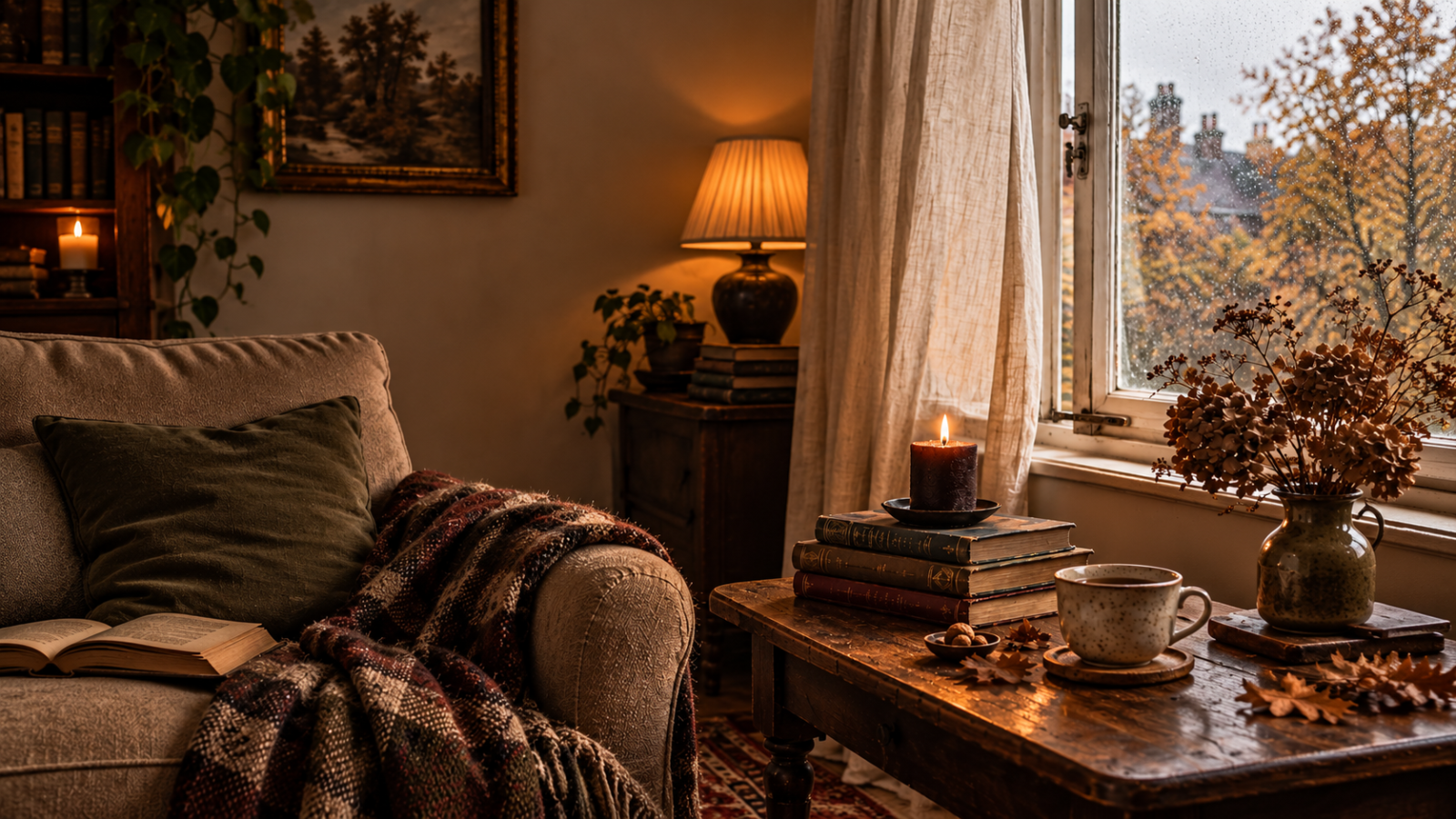
It smells of damp leaves settling into cold earth, rain-soaked wool drying beside an open window, bitter walnut hulls, and the faint trace of distant woodsmoke. There is something mineral about it, something woody and slightly bitter. It is a season of beautiful contradictions: warmth sought against the cold, familiar rooms made unfamiliar by the changing light, and the quiet pleasure of coming indoors after being outside.
Bringing that atmosphere into the home requires surprisingly little. Not a collection of seasonal decorations or an overpowering fragrance, but a willingness to take our cues from the weather itself.
Autumn Home Fragrance: Earth, Bark and Moss
The most interesting autumn fragrances often begin close to the ground.
Dry moss, vetiver, cedarwood, black tea and the darker facets of patchouli can suggest woodland paths, weathered timber and soil disturbed by rain. They offer depth without necessarily introducing sweetness, creating an atmosphere that feels settled rather than deliberately festive.
Vetiver, in particular, can have a wonderfully dry, root-like quality, while cedarwood brings to mind old cupboards, pencil shavings and timber warmed by years of use. Black tea lends a subtle bitterness, something almost tannic, that sits beautifully alongside wood and moss.
There is no need for every note to be immediately recognisable. A good room fragrance should create an impression rather than reproduce a landscape with literal accuracy.
Think of the difference between a room that smells unmistakably of a scented candle and one in which you simply notice something pleasing in the air.
The latter is often far more interesting.
Allowing the House to Breathe
Before introducing fragrance, let the house have a little fresh air.
Open the windows for ten minutes in the late afternoon, when the light is beginning to fade and the air has acquired that unmistakable autumn chill. Let the lingering warmth of the day escape. Notice how the room changes when the outside world is briefly allowed in.
Then close the windows, draw the curtains and, if you wish, light a candle with a dry, woody or resinous character.
The contrast is part of the pleasure. A cool room gradually becoming warm again, the small movement of a flame, the almost imperceptible arrival of scent.
Fragrance need not announce itself the moment someone enters. Sometimes it is enough that it becomes noticeable only after a few minutes, as though it has always belonged to the room.
Choosing Fragrance for the Room, Not the Season
It is tempting to think of autumn scent as a single category, but different rooms ask for different things.
A sitting room with books, soft furnishings and wooden furniture may suit a quiet composition of cedar, tea or dry woods. In a hallway, something greener or more mineral can feel refreshing, particularly when it echoes the damp air outside.
A bedroom, meanwhile, may need very little fragrance at all. Clean linen, a slightly open window and the natural smell of the room can be more comforting than any candle.
The character of the space matters as much as the fragrance itself. A heavily scented room can feel smaller and more enclosed, while a restrained scent leaves room for the other details that make a home feel lived in.
There is also no reason to scent every room in the house. Moving between spaces with different atmospheres can be a pleasure in itself.
The Beauty of a Barely There Scent
Perhaps the most overlooked aspect of home fragrance is restraint.
We tend to judge scented products by their strength, as though a fragrance that fills the entire house must somehow be more successful than one that stays close to its source.
Yet the opposite can be true.
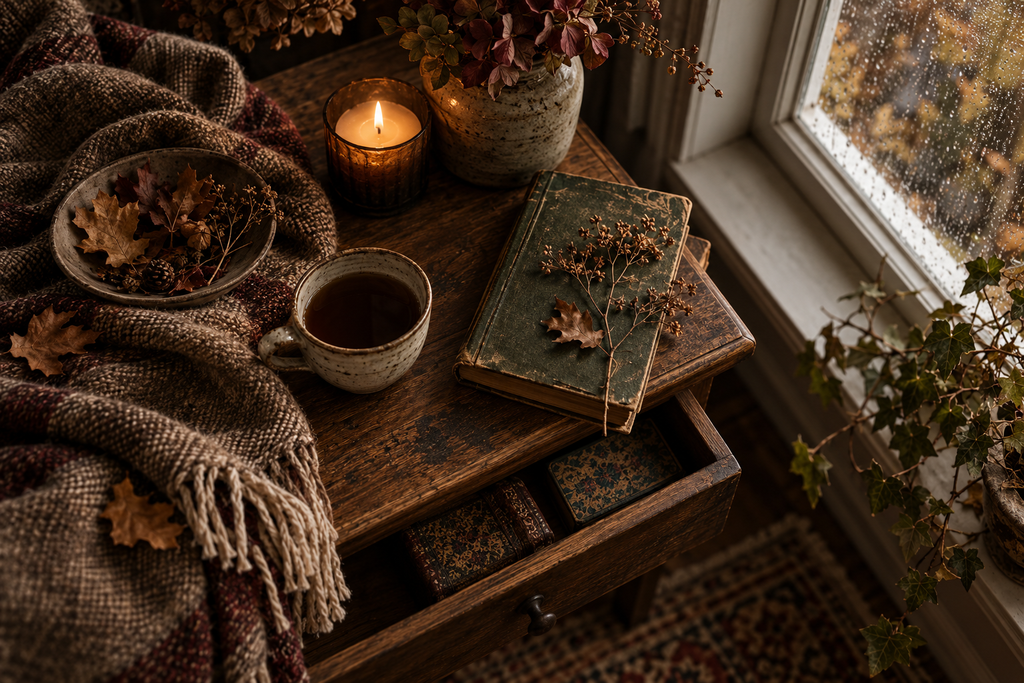
A trace of cedar in the sitting room, a suggestion of pine near the fireplace, or the faint earthy smell carried in on a coat after a walk can be enough to establish the mood of an autumn evening.
And some of the loveliest seasonal scents require no fragrance product whatsoever.
An old wooden drawer opened after months of being closed. A pot of black tea left to steep. Rain against the windowsill. The smell of a woollen blanket brought out for the first cold evening.
These are small, ordinary experiences, but they give a home a sense of season that cannot be manufactured.
Let Autumn Smell Like Autumn
There is nothing inherently wrong with vanilla, cinnamon or the comforting smell of baking. They have their place, and for many people they carry genuine memories of home.
But autumn has a wider vocabulary than sweetness.
It can be dry and bitter, green and smoky, earthy and unexpectedly fresh. It can smell of old books, wet stone, dark wood and the first fire of the season.
Perhaps the most thoughtful way to scent a room for autumn is not to impose an idea of cosiness upon it, but to pay attention to what the season is already offering.
Open the window. Let the cold air in. Light a candle if the moment calls for one.
And leave a little space for the house to smell like itself.
Further reading: Warm Ambient Lighting: The Art of a Cosy Evening