A quieter kind of Christmas greenery.
Every December, a certain tyranny sets in. A seven-foot Nordic fir must be wrestled through a doorway, shed needles across the hallway until February, and be decorated in a manner that suggests you have a team.
Preferably one with a ladder, a considerable amount of patience and an alarming number of matching baubles.
I would like to propose a rebellion. A small one. Rather beautiful, and entirely free of tinsel.
I have nothing against Christmas trees. A magnificent tree, thoughtfully decorated, can be a wonderful thing. But somewhere along the way, the tree seems to have become less of a pleasure and more of an obligation. As though December cannot properly begin until a substantial portion of the living room has been surrendered to a conifer.
And if you’re looking for Christmas greenery ideas that don’t involve an actual tree, I think the most interesting possibilities begin with what we choose to leave out.
The forest does not need to be conscripted whole.
Sometimes a single gesture will do. A branch with an interesting silhouette. A length of pine allowed to fall naturally over an old mirror. Winter flowers whose beauty owes very little to festive convention.
Here are four ways to bring the forest indoors, each a little theatrical, each considerably easier than the traditional tree, and none requiring an entire weekend devoted to untangling lights.
I. The Foraged Branch
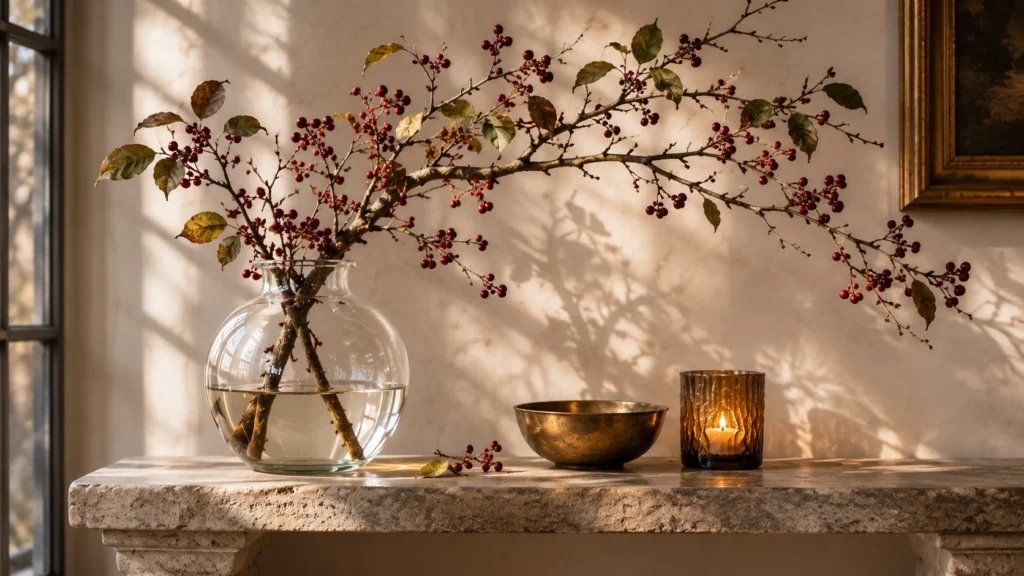
One branch. One vase. Remarkable restraint.
Begin with the simplest gesture of all.
A single long branch, perhaps bearing berries or a few remaining leaves, arching out of a clear glass vase and across a stone console, can do more than a whole forest of baubles.
The secret is in the silhouette.
Look for something with movement rather than perfect symmetry. A branch that bends slightly to one side, divides unexpectedly or carries a few smaller twigs in interesting directions will create a more compelling arrangement than anything rigidly upright.
And resist the temptation to correct its irregularities. Nature has already done the arranging.
Choose a vase with enough weight and a sufficiently broad base to support the branch without tipping. A tall, narrow vessel may look elegant, but an ambitious branch can quickly turn it into a small domestic engineering problem.
Clear glass is particularly beautiful here. It allows the stems and water to become part of the composition, rather than concealing them.
Keep the supporting cast small. A brass bowl, a short stack of books you have genuinely read, perhaps a candle in amber glass, placed safely away from the foliage.
The branch is the entire argument, and everything else just nods in agreement.
I particularly like this arrangement against a pale wall, where winter daylight can cast the most delicate shadows. The empty space around the branch is as important as the branch itself.
A little restraint gives it room to be noticed.
If you forage, collect fallen material where permitted or take cuttings only with the landowner’s permission. Leave berries and other valuable winter food for the birds whenever possible. For a longer-lasting arrangement, make a fresh cut at the base of suitable woody stems, place them in clean water and change it regularly.
There is no need to bring half the hedgerow home.
II. The Pine Garland
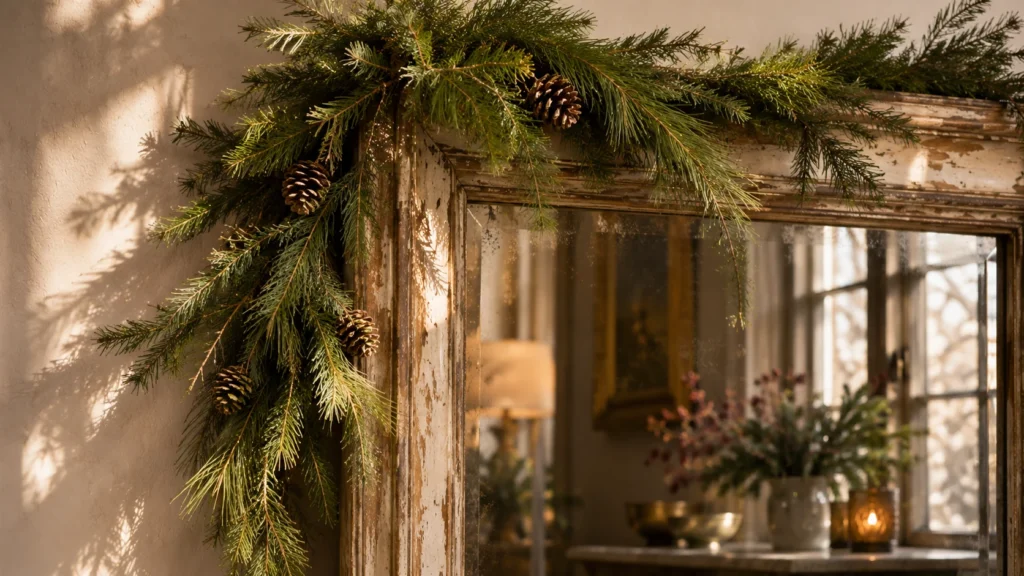
Drape it. Do not tame it.
Garlands have a reputation for being tidy, symmetrical and faintly municipal.
Ignore that.
The most beautiful greenery rarely looks as though it has been measured with a ruler.
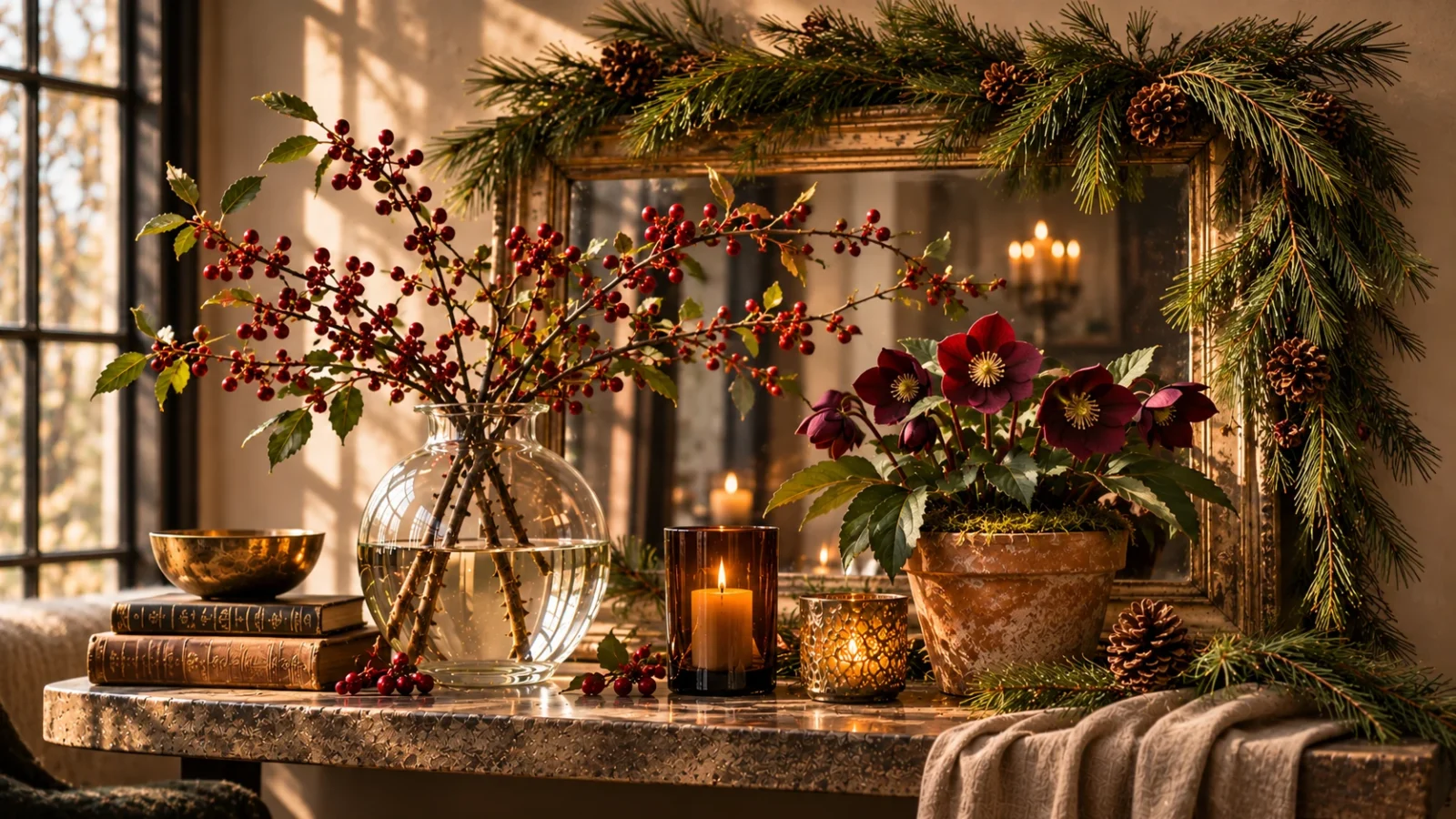
Take a generous length of fresh pine and allow it to fall loosely over a weathered mirror, an old doorframe or a substantial mantelpiece. Let one side descend further than the other. Allow the smaller branches to escape the main line rather than forcing everything into a perfectly obedient curve.
A few pinecones may be tucked among the needles, although I prefer them used sparingly. They should look as though they belong to the greenery, not as though someone has been particularly enthusiastic with a glue gun.
The beauty is in the contrast.
Soft, fragrant green against chipped, aged wood. Something alive against something that has plainly been around for a while.
A distressed frame is ideal because it makes the greenery look as though it grew there, rather than having been delivered on Tuesday.
If the mirror is large, resist the urge to surround its entire perimeter. A generous sweep across one upper corner, falling down a single side, often has far more presence.
The asymmetry feels relaxed, but it is not accidental. There is a difference between allowing something to fall naturally and leaving it to collapse wherever gravity takes it.
Use discreet, secure fixings appropriate to the surface and the weight of the greenery. Fresh branches are heavier than they appear, and drying foliage can become brittle. Keep garlands away from fireplaces, candles, hot lights and other heat sources.
And do not underestimate the scent.
Real pine contributes something that no festive candle in an elaborately illustrated tin can quite reproduce. Its sharp, resinous freshness is particularly lovely when you enter a room from the cold.
Sometimes the most effective Christmas decoration is the one you notice before you see it.
III. Hellebores
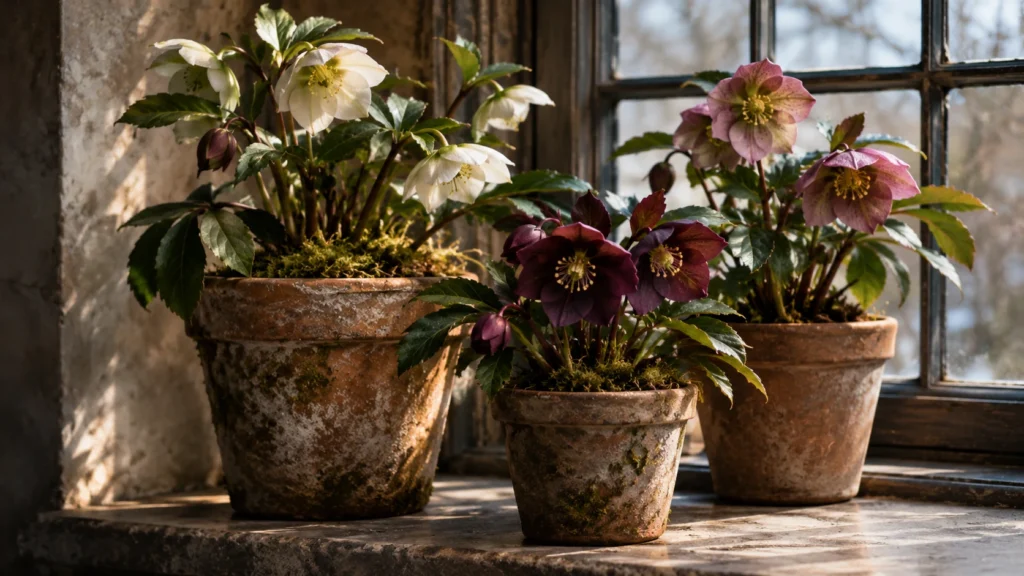
The Christmas rose, for those with slightly darker tastes.
If pine is about familiar Christmas tradition, hellebores offer something altogether more intriguing.
They flower in winter, often when the garden has very little else to say for itself. Their nodding heads appear in shades of ivory, dusty pink, plum and deep burgundy, sometimes with a small golden centre that looks rather pleased with itself.
They have all the moodiness of a Gothic heroine and none of the fuss.
I am particularly drawn to the darker varieties. Their colours are wonderfully difficult to pin down: somewhere between old wine, bruised velvet and the deepest part of a winter rose.
There is nothing conventionally cheerful about them.
Which, of course, is part of their charm.
Instead of arranging cut flowers in an elaborate vase, I would use two or three potted hellebores in aged terracotta. Set them together on a cool windowsill or a sheltered console where natural light can reach their petals.
Vary the heights slightly. One taller pot beside two lower ones feels more collected than three identical containers arranged with military precision.
A little moss on the soil, if appropriate, and the worn surface of the terracotta are quite enough. There is no need for ribbons, miniature ornaments or a small wooden sign announcing the season.
The flowers are perfectly capable of speaking for themselves.
Hellebores generally prefer cool conditions, so avoid placing them beside a radiator or in a hot, centrally heated room for extended periods. A bright, cool position suits them better, and potted plants can return outdoors to appropriate growing conditions afterwards.
One practical caution: hellebores are poisonous if eaten and can irritate the skin. Keep them away from curious pets and children, and wear gloves when handling or cutting them.
Beautiful things so often come with small print.
IV. Suspended Pine
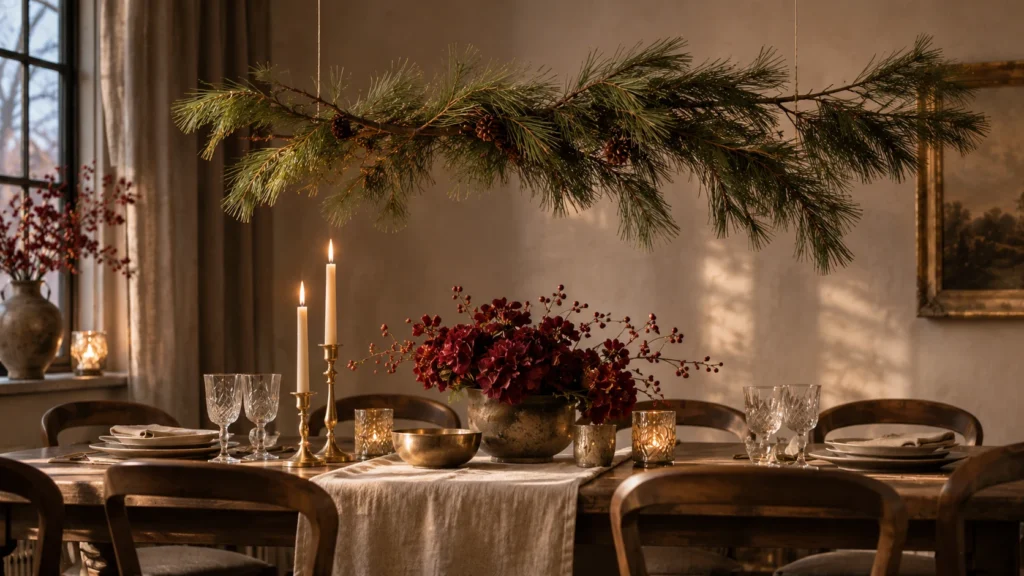
Look up. Nobody ever does, which is the point.
Now for the most theatrical gesture of the four.
Imagine a long pine bough suspended horizontally above a dining table, its branches spreading outward in an irregular, almost sculptural line.
It appears to float over the evening.
No tree stand. No occupied corner. No furniture rearranged to accommodate a seasonal visitor of considerable size.
Just greenery, light and a little unexpected drama.
The arrangement works particularly well over a long, narrow table, where the horizontal shape echoes the proportions below. Choose a bough with enough presence to be noticed, but not so much density that it feels like dining beneath an entire section of woodland.
The key is to keep the table itself relatively quiet.
A linen runner. A few beautiful glasses. Low arrangements of deep burgundy flowers. Perhaps a small brass bowl or two.
The greenery supplies the drama above while the table carries on being civilised below.
And because the decoration occupies the space overhead, the table remains available for the rather important business of dinner.
There is something wonderfully architectural about suspended greenery. It changes how we perceive a room, drawing the eye upward and giving an ordinary dining space a temporary sense of occasion.
But this is one arrangement where beauty must be accompanied by a little engineering.
Use secure fixings suitable for the structure above, appropriate supports and a suspension method rated for the full weight of the greenery. Do not rely on decorative hooks or plasterboard alone. The bough must remain stable and well clear of anyone’s head.
I would also avoid real candles beneath it altogether. Dried pine is flammable, and even fresh greenery should be kept well away from heat, flames and electrical fittings.
If you want the atmosphere of candlelight, place suitable LED candles on the table instead.
Pine is lovely, but it is not fireproof, and it is no way to end a dinner party.
The Quiet Point
I suspect what appeals to me most about these arrangements is not simply that they occupy less space than a traditional Christmas tree.
It is that they ask us to look more closely.
At the shape of a branch. The colour of a winter flower. The way greenery falls against old wood, or catches the light above a table.
There is pleasure in choosing one beautiful thing and allowing it to be enough.
Not every surface needs decorating. Not every corner needs a seasonal arrangement. And not every Christmas tradition must be followed simply because we have followed it before.
A few carefully chosen elements can give a room a sense of occasion without overwhelming everything that makes it feel like home for the other eleven months of the year.
None of this requires a tree, a trip to a garden centre at the worst possible hour, or a spare weekend.
It requires a few thoughtfully chosen branches, a good eye and the willingness to leave some empty space around them.
Empty space is where greenery looks its best.
A tree says Christmas is here.
A single branch in a glass vase says it too, only more softly, and with better manners.
Natural accents. Lasting impact.