The art of a welcoming home begins long before we reach the living room.
There is something rather revealing about an entrance hall.
Before we have seen the living room, admired the kitchen or discovered the particularly comfortable armchair by the window, the entrance has already introduced us to the house.
It offers the first glimpse of its personality. A little hint of what lies beyond.
And yet, for a space entrusted with such an important responsibility, the humble hallway is remarkably often treated as an afterthought.
A place for coats, shoes, keys and the occasional umbrella that has somehow survived three house moves.
I think it deserves rather better.
After all, the entrance hall is not merely a place we pass through. It is the opening sentence of our home’s story.
And personally, I have always appreciated a good opening sentence.
A First Impression Worth Making
The most beautiful entrance halls are not necessarily the grandest.
Of course, a sweeping staircase, magnificent proportions and an antique chandelier can make quite an impression. But a small hallway can be every bit as memorable when it has been thoughtfully considered.
What matters is the feeling it creates.
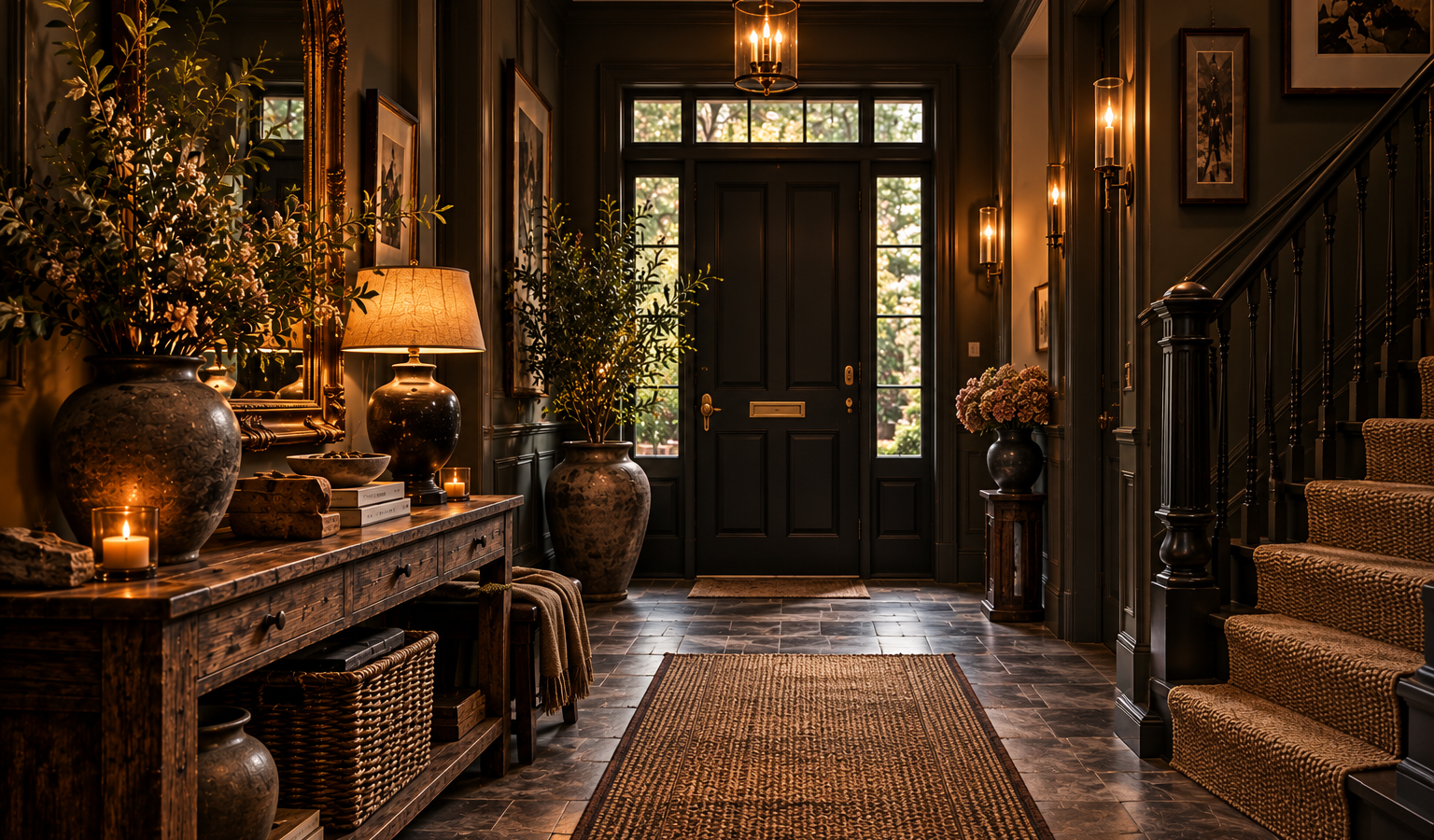
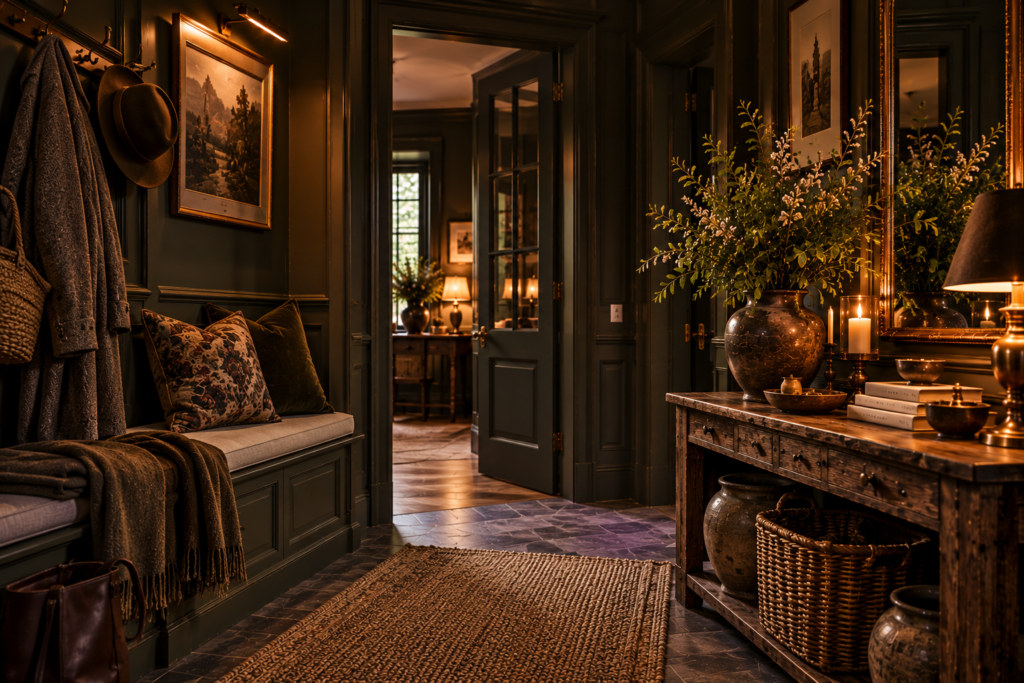
Perhaps it is the warmth of a table lamp against a dark wall. The quiet elegance of a beautifully aged wooden console. A large mirror reflecting the last of the afternoon light.
Or simply the sense that everything belongs.
I have always preferred spaces with a little depth and personality to those that seem determined to look immaculate at all costs.
An entrance should feel welcoming, not as though one has accidentally wandered into an exceptionally expensive furniture showroom.
There is a difference.
The Quiet Drama of Darker Colours
There is a particular beauty in a darker entrance hall.
Deep olive, tobacco brown, charcoal, muted aubergine or a wonderfully complex shade of almost-black can give even a modest space an unexpected sense of intimacy.
Contrary to the old belief that every small hallway must be painted white to make it appear larger, darker colours can create depth rather than simply emphasise the room’s boundaries.
They can also make the transition from the outside world feel wonderfully deliberate.
One moment, the noise and brightness of the day. The next, a softly lit space that seems to invite you to leave all that behind.
I find that rather appealing.
Of course, dark walls need not mean a gloomy entrance. Warm lighting, reflective surfaces, natural wood and carefully chosen details can bring a beautiful balance.
The intention is atmosphere, not the sensation of entering a Victorian detective novel.
Although, admittedly, I wouldn’t object to a little mystery.
Furniture With a Past, or at Least a Personality
One of the easiest ways to give an entrance hall character is to resist the temptation to furnish it entirely with pieces that look as though they arrived together in the same delivery van.
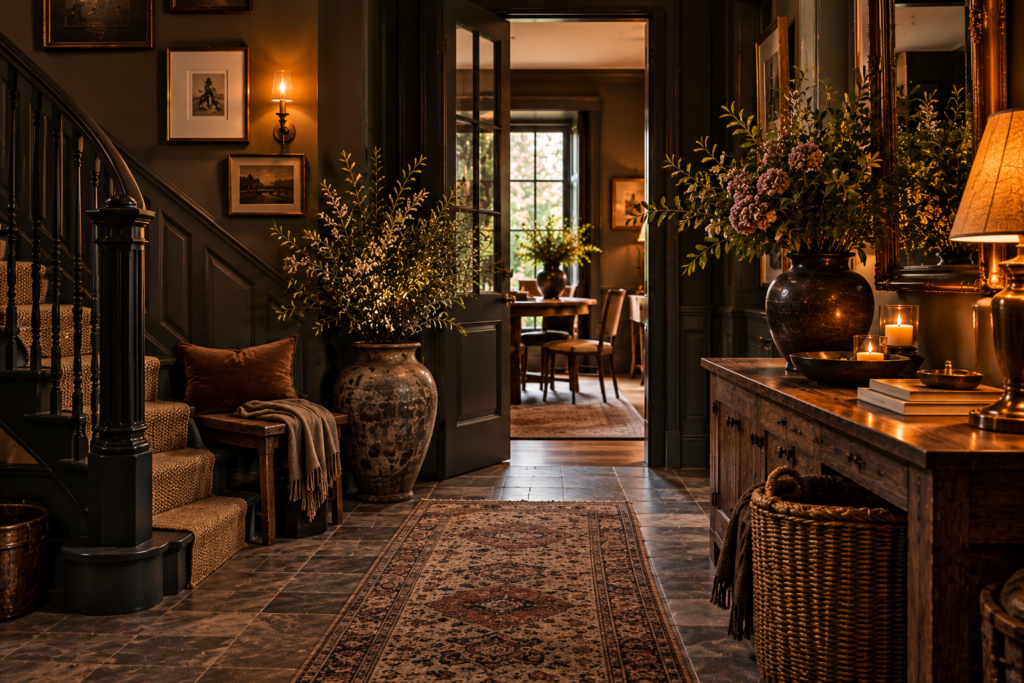
A vintage console, an old wooden chest or a beautifully proportioned side table can introduce a sense of history that new furniture sometimes struggles to imitate.
I particularly love wood with visible grain, subtle imperfections and a finish that has softened with age.
There is something reassuring about objects that do not pretend to be brand new.
And a hallway is a lovely place for a single piece of furniture to take centre stage.
It need not be expensive or particularly elaborate. A simple wooden table beneath a beautiful mirror can be more compelling than an entire collection of decorative accessories.
Especially when those accessories appear to have been selected primarily because somebody decided that a hallway required precisely seven of them.
Sometimes, less really is more.
But less should never mean devoid of character.
Lighting Changes Everything
If there is one thing I would never underestimate in an entrance hall, it is lighting.
A single harsh ceiling light can make even a beautifully decorated space feel strangely uninviting.
A softly glowing table lamp, on the other hand, can transform an ordinary hallway into something wonderfully atmospheric.
I love the way warm light settles over wood, catches the edge of a mirror and creates gentle shadows along a wall.
It makes a space feel inhabited.
Wall sconces can be equally lovely, particularly in narrow hallways where there is little room for furniture. And if the proportions allow, a pendant light with a little character can become a beautiful focal point.
The secret is not necessarily more light, but better light.
Enough to welcome us home, without making us feel as though we are being interrogated about where we have been.
A distinction I consider rather important.
The Beauty of a Few Carefully Chosen Things
An entrance hall does not need an elaborate display to feel complete.
A generous mirror, a ceramic vase with a few branches, a small piece of art or an interesting antique object can give it all the personality it needs.
I particularly like the contrast between something refined and something a little imperfect.
A beautifully framed mirror above a weathered wooden console. A sculptural lamp beside an old ceramic bowl. Fresh greenery against dark walls.
These combinations create interest without making the space feel overly arranged.
And mirrors are particularly useful in an entrance, not simply because they reflect light and lend a sense of openness, but because they introduce another layer to the room.
Although I suspect most of us also appreciate the opportunity for one last glance before leaving the house.
A perfectly legitimate design consideration, in my opinion.
A Beautiful Entrance Must Still Work
Of course, an entrance hall has responsibilities beyond looking lovely.
Coats need somewhere to hang. Shoes need a home. Keys should ideally be found without conducting a small archaeological excavation every morning.
And however much I admire a beautiful antique console, I would rather not have to negotiate my way around it every time I bring in the shopping.
Practicality matters.
A narrow bench can provide somewhere to sit while putting on shoes. A discreet basket can hold everyday essentials. Hooks, cupboards or cleverly concealed storage can keep the inevitable clutter under control.
The trick is to make these practical elements feel like part of the room rather than an apology for its existence.
A home should accommodate the way we actually live.
Not the imaginary version of ourselves who owns only two coats, never misplaces a key and somehow manages to keep every pair of shoes permanently out of sight.
I have yet to meet this person.
The Feeling of Coming Home
Perhaps the loveliest thing about a thoughtfully designed entrance is that we get to experience it every day.
It is not simply there to impress visitors.
It is there to welcome us back.
After a long day, there is something quietly comforting about opening the front door and stepping into a space that feels familiar, beautiful and unmistakably ours.
The gentle glow of a lamp. The warmth of wood. A favourite picture on the wall. The small, ordinary details that make a house feel like home.
None of these things needs to be particularly grand.
They simply need to feel right.
And while I love an entrance that makes a beautiful first impression, I think the most successful ones offer something even better.
They make us happy to come home.
Because the entrance hall may be the opening sentence of our home’s story.
But it is also the place where we return to it, day after day.