On softer light, deeper colours, familiar rituals, and the pleasure of letting a room follow the season.
There is a particular moment in autumn when a home begins to ask for something different.
It rarely happens on the first of September, or even with the first yellow leaf. It happens when the afternoon light begins to disappear a little earlier, when an open window no longer feels quite so inviting, and when the room that seemed perfectly comfortable in July suddenly feels as though it could do with another layer.
Not a transformation. Just a change of mood.
We tend to think of seasonal decorating as something we add to a room: a wreath, a collection of pumpkins, perhaps a few objects in colours we would never consider during the rest of the year. But the most beautiful autumn interiors often announce the season without a single recognisable autumn decoration.
They simply feel different.
Begin With the Light
If summer belongs to daylight, autumn belongs to lamps.
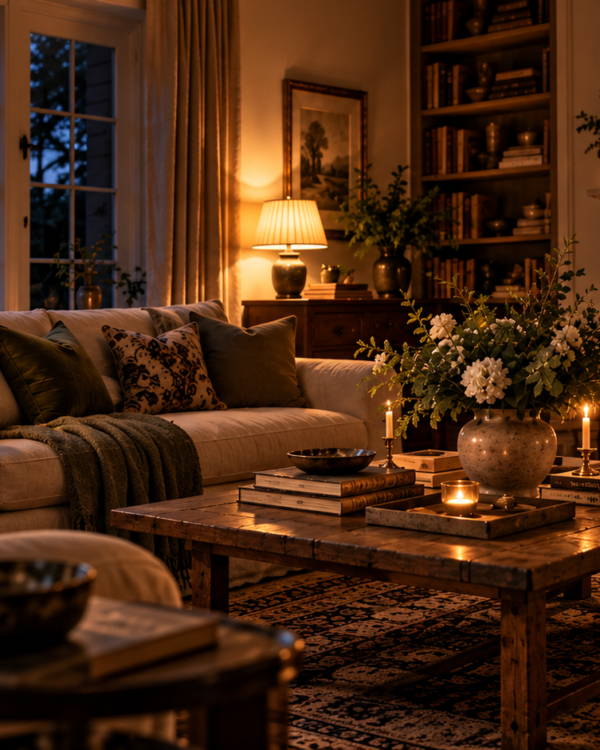
There is something wonderfully civilised about turning on a table lamp before the evening has properly arrived. The light gathers in small pools, leaving the corners of a room to their own devices. Suddenly, a familiar chair looks more inviting. A stack of books acquires a little mystery. Even an ordinary cup of tea becomes part of the atmosphere.
Overhead lighting has its uses, but it rarely creates the sort of intimacy we instinctively seek as the evenings draw in.
Instead, think in layers: a shaded lamp beside a sofa, a small light on a bookshelf, perhaps a candle on the dining table.
A room need not be brightly illuminated to feel welcoming. Sometimes the most beautiful thing about light is what it chooses not to reveal.
Let the Colours Deepen
Autumn does not require a house full of orange.
Its most compelling colours are often far quieter: tobacco brown, aged olive, oxblood, aubergine, smoky blue, and the almost-black green of leaves after rain.
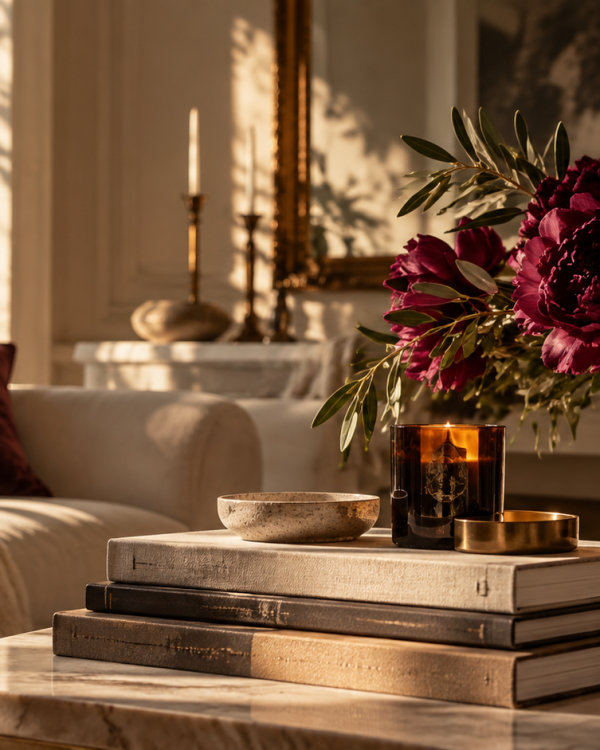
These shades have a depth that feels particularly appropriate when the light softens. They also sit beautifully alongside things that have already earned their place in a home: dark wood, antique brass, old leather, worn book covers, and natural stone.
There is no need to repaint a room every season. A deep-coloured cushion, a throw in a richer shade, or even a collection of books with beautifully aged spines can subtly change its character.
The aim is not to make a room look autumnal.
It is to make it feel as though autumn belongs there.
Add Texture, Not Clutter
As the temperature falls, texture becomes almost as important as colour.
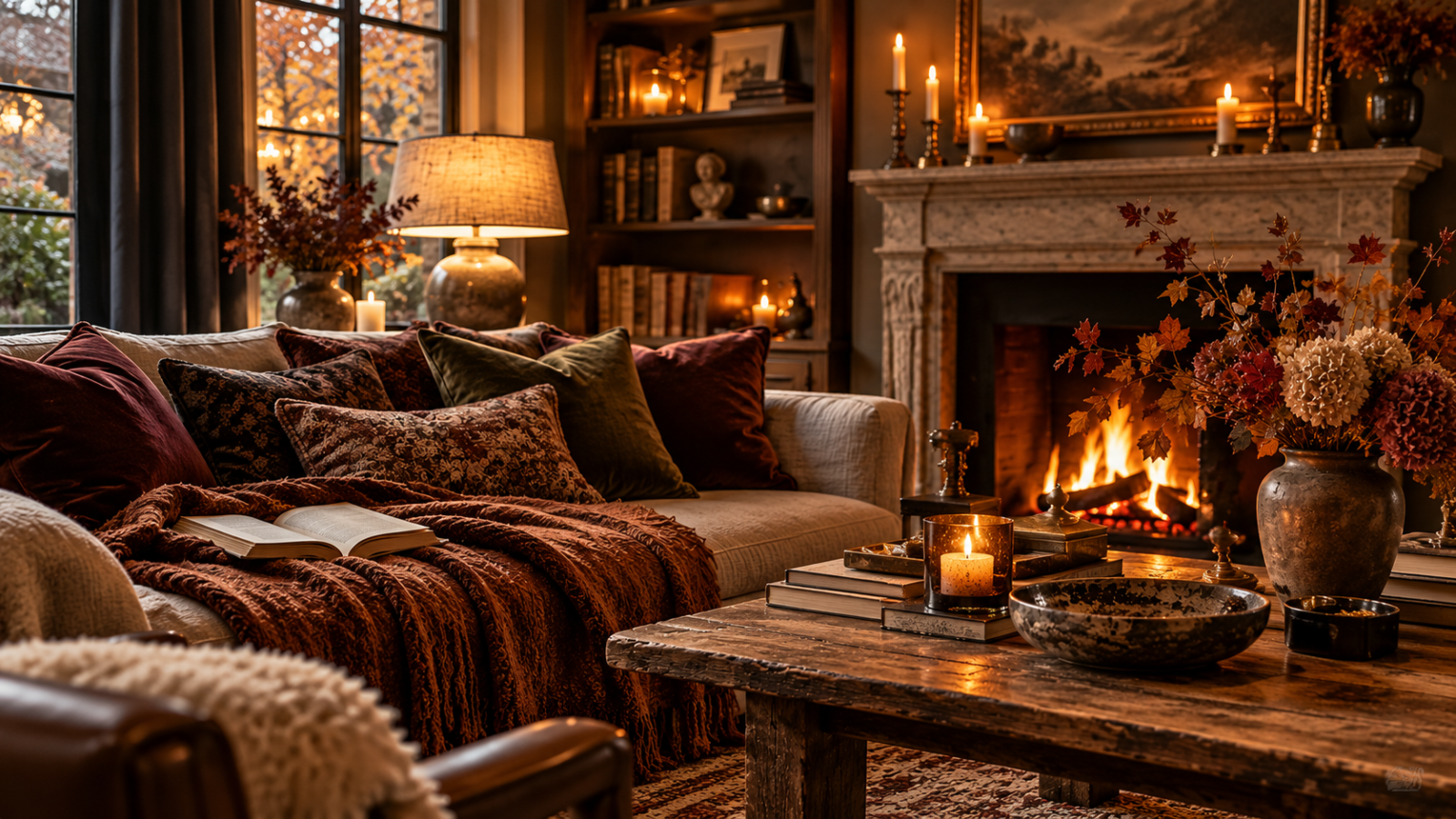
Linen that felt wonderfully crisp in summer may now benefit from the company of wool. A velvet cushion catches the evening light differently from cotton. A generously woven throw makes a sofa look as though someone has just stepped away from a very good book.
The secret is variation rather than quantity.
A room filled with cushions and blankets can still feel strangely impersonal if everything is new, identical, and arranged with excessive precision.
One beautiful wool blanket, casually folded over the arm of a chair, may say more than six carefully coordinated throws.
Comfort should look lived in, not staged.
Make Room for Small Rituals
Perhaps the loveliest thing about autumn is that it gives us permission to slow down.
The morning coffee becomes a little more deliberate. We return to books abandoned during the brighter months. Dinner is eaten by lamplight rather than in the last of the evening sun.
A home feels different when it accommodates these small rituals.
Consider the places where you naturally pause. Is there somewhere comfortable to read? A table beside your favourite chair? A lamp that makes an ordinary Tuesday evening feel quietly special?
These details matter more than seasonal ornaments because they change how a room is actually used.
And that, surely, is the point of making a home beautiful.
Let Scent Become Part of the Atmosphere
Every home has a scent, whether we choose it or not.
In autumn, I find myself drawn towards fragrances with a little more warmth and substance: dry woods, soft resins, amber, perhaps a trace of incense or something gently spiced.
Not necessarily sweet. Certainly not overwhelming.
A beautifully scented room should invite someone to linger, rather than announce itself before they have taken off their coat.
A candle, a subtle diffuser, or simply the familiar aroma of coffee and old books can become part of the season’s character.
Scent has a remarkable ability to turn an ordinary moment into a memory. Long after we have forgotten how a room was arranged, we may remember exactly how it smelled.
Allow a Little Imperfection
Some of the most appealing autumn rooms have an almost accidental quality.
A book left open on a side table. A slightly rumpled linen cushion. A branch brought indoors and placed in an old ceramic jug. A favourite cardigan resting over the back of a chair.
These are not decorating techniques so much as signs of life.
There is a temptation, particularly when looking at beautifully photographed interiors, to remove every trace of ordinary existence. Yet a home without evidence of the people who live there can feel curiously unfinished.
Autumn seems particularly forgiving of imperfection.
Perhaps because the season itself is an exercise in beautiful disorder.
A Home That Follows the Season
The pleasure of an autumn home is not in making it look entirely different from the one we loved in summer.
It is in allowing the same rooms to respond to a change in light, temperature, and rhythm.
A little more texture. A little less brightness. Colours that seem to deepen as the evenings lengthen. Familiar objects taking on a different character.
Nothing dramatic needs to happen.
Sometimes autumn arrives in a room with nothing more than the click of a lamp, the weight of a wool blanket, and the quiet satisfaction of being exactly where you want to be.